
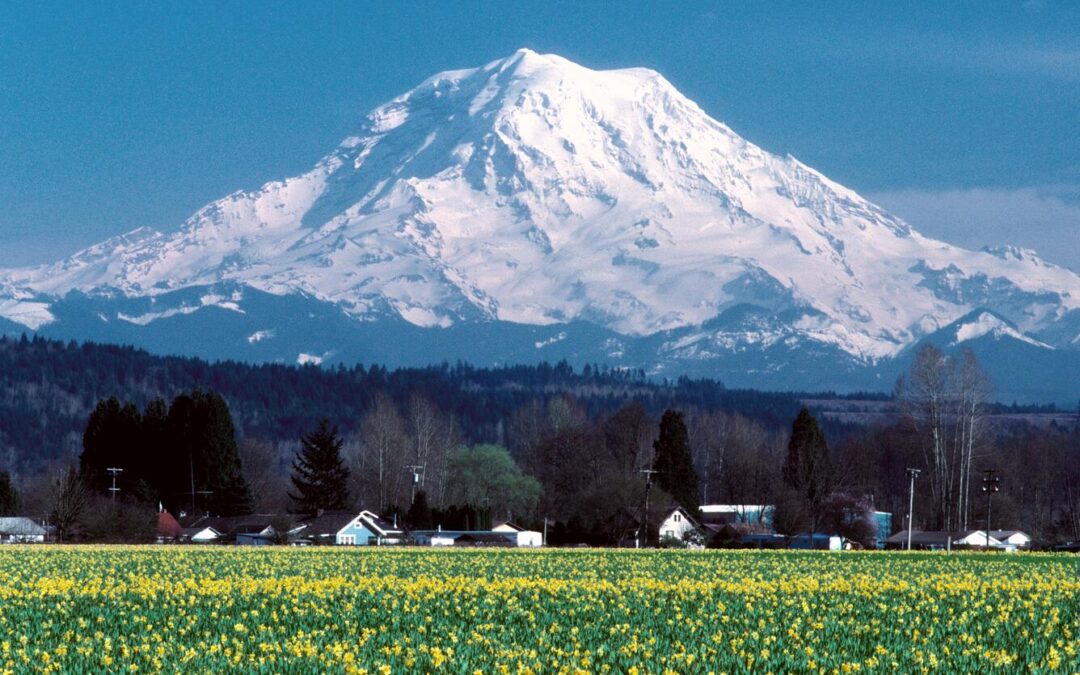
Mount Rainer has long been a destination for climbers. Standing 14,410 feet in the state of Washington, it is the fifth-tallest mountain in the continental United States. With more than 20 named routes, the active volcano presents a range of challenges for those wanting to reach its summit.
While thousands of mountaineers succeed in reaching the summit each year, nearly just as many fail, and deaths are far from unheard of, meaning climbing Mount Rainier is not something to be taken lightly. Considering trying your hand at ascending the mountain originally known as Tahoma? Keep reading to learn about Mount Rainier’s history and what you need know before tackling it.
History
Before it took on its English name, Mount Rainier was called “Great Snowy Peak,” which translates to “Tahoma,” by the Yakima Indians. The name was well chosen, as Mount Rainer is the most glaciated peak in the continental United States. In 1792, it took on its current moniker when British explorer Captain George Vancouver named it for Admiral Peter Rainier of the British Navy after Vancouver spotted it on a scouting expedition.
The first ascent may have occurred in 1852, but the first recorded one was completed in 1870. In 1899, President William McKinley signed legislation making Mount Rainier National Park the nation’s fifth national park. The park encompasses 365 square miles, an area that includes 25 large glaciers.
Preparation
To climb Mount Rainer, mountaineers need to pay a fee ($70 in 2025) that helps to cover the costs of rangers and other staff and resources. After paying the fee, which should be done online, climbers need to secure a climbing permit.
Climbers may secure a permit to climb solo or with a partner or group. In addition, several companies offer guided climbs. Because of the risk of dangerous conditions, monitoring the weather forecast is a must prior to any ascent.
Being in excellent physical condition is also a must, as is obtaining the proper equipment. Doing so mitigates the risk of danger while ascending any of Mount Rainier’s 20 named routes, each of which involves climbing approximately 10 miles while navigating more than 9,000 feet of elevation gain. These routes are considered technical climbs because they involve crossing glaciers and icefields, and using ice axes, crampons, and ropes.
Of these routes, the following four are the ones attempted by the overwhelming majority of mountaineers. Let’s learn more about each.
Disappointment Cleaver
Approximately 75% of summit attempts are made via Disappointment Cleaver. As a testament to its difficulty, only about half of those attempts are successful.
With an alpine grade of II and a maximum grade of 35 degrees, Mount Rainer’s easiest route is nonetheless considered moderately challenging and requires experience with crampons, ice axes, belaying, navigation, and crevasse rescue. Summiting typically takes two days, though some climbers may need as many as three or as little as one.
The climb begins at Paradise Ranger Station and follows a well-defined path up the mountain’s southeastern flank. Along the way, climbers will have to navigate crevasses, steep switchbacks, and snow bridges, as well as be prepared for rockfall and changing glacier conditions.
Emmons-Winthrop
Mount Rainier’s longest summit route is considered a step up in difficulty from Disappointment Cleaver. While it has a more gradual approach, its added length, sustained travel time over glaciers, and increased pack loads means climbers need to have especially strong endurance.
Emmons-Winthrop lacks ladders, fixed ropes, or other forms of assistance and is less defined than Disappointment Cleaver. Route finding can be a challenge as a result, so climbers should have advanced navigation skills. Large crevasses and avalanche risks are just a few of the potential hazards.
Emmons-Winthrop starts at White River Campground and leads climbers up Inter Glacier, then Emmons Glacier, though the exact route can vary from year to year. Before reaching the summit, climbers typically have to navigate a longitudinal ridge, an alpine meadow, and a bergschrund crevasse.
Kautz Glacier
The oldest route up Mount Rainier extends for approximately 10-11 steep, technically challenging miles to the summit. Along the way, climbers have to contend with seracs, complex crevasses, and potential icefalls.
Kautz Glacier begins at Paradise Range Station and typically takes three to four days to complete, though the fittest of climbers may need as little as two. Rated as difficult, the route has an approximately 50% completion rate and is more secluded than Mount Rainier’s other popular climbs.
There are two potential approach to Kautz Glacier, each of which involves a long trek through untamed wilderness. Upon reaching the glacier portion, climbers have to navigate ice slopes as steep as 60 degrees. Given these challenges, the route is recommended for intermediate to advanced climbers.
Liberty Ridge
Named one of the “50 Classic Climbs of North America” more than 40 years ago, Liberty Ridge has a reputation for difficulty that precedes itself. As a testament to that difficulty, the route is attempted by only 100 mountaineers each year.
With an alpine grade of III+, Liberty Ridge should be attempted only by expert climbers. Proper conditioning is paramount, as the route involves making a committed ascent up steep terrain.
That terrain includes Inter Glacier, Winthrop Glacier, and Curtis Ridge, the latter of which has dangerous exposure. Liberty Ridge typically takes between two and four days to complete.